Description
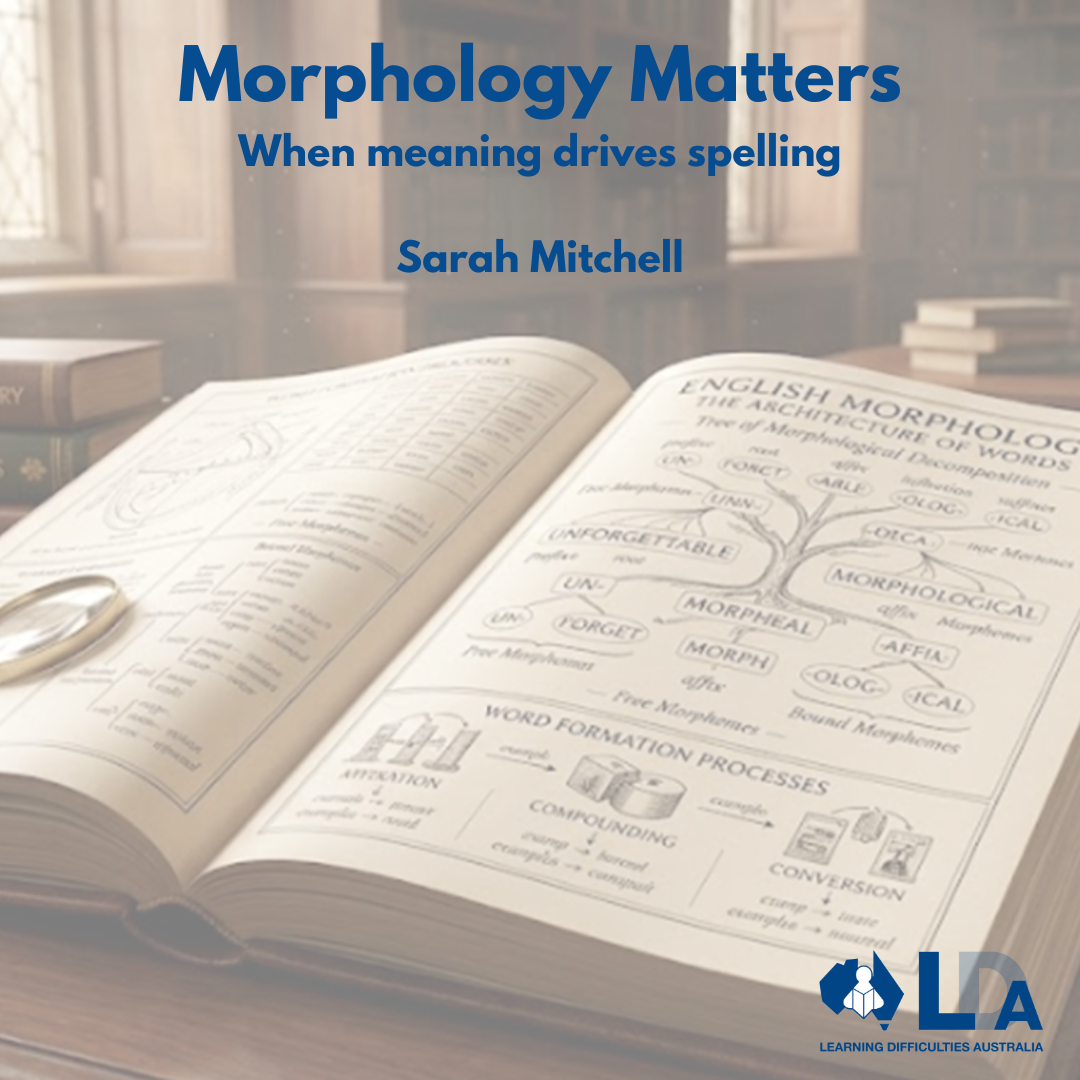
Morphology is often seen as something that comes later — once phonics is secure and decoding is established. In practice, morphology is one of the organising principles of English spelling and plays a central role in how words carry meaning across reading and writing.
This 30-minute professional development session provides a clear and practical understanding of what morphology is, what is essential to focus on, and how teachers can interact with it confidently in the classroom. The emphasis is not on terminology or exhaustive word analysis, but on understanding the parts of English that stabilise spelling and support meaning.
Participants will explore how morphemes preserve structure across related words, why pronunciation can shift while spelling remains consistent, and how this knowledge strengthens decoding, encoding, vocabulary, and sentence construction. The session will also examine common student spelling errors to distinguish phonological issues from morphological misunderstandings, supporting more precise instructional decisions.
Teachers will be guided through a short, explicit teaching sequence that can be implemented immediately. Using a single base word, the session demonstrates how morphology can connect spelling patterns, word meaning, grammar, and sentence-level application in a cohesive and manageable way.
Designed for educators working within a structured literacy framework, this webinar positions morphology not as an add-on, but as a practical tool for making English spelling, reading, and meaning work together.
About Sarah Mitchell
M. Sp. Ed., B.Ed. (Primary), Grad Dip. OCR Level 7, Grad Cert. OCR Level 5
Specialist Teacher / Assessor
Author – Teaching Structured Literacy
Sarah holds a Master of Education (Advanced Research) and has specialised in structured literacy and morphology instruction for older students with persistent reading and spelling difficulties for almost two decades. She has worked across mainstream and specialist settings in Australia and internationally, including middle years classrooms (Years 5–8).
Her work centres on translating research into practical, defensible classroom decisions, particularly for students who have not responded to typical approaches.
Course Points: 0.5
Cost:
LDA Member: Free (see your My Courses page)
Student Member: Free (see your My Courses page)
Non-Member: $15
Reviews
There are no reviews yet.